第 9 节 · 最小 Agent Loop 的 5 个核心点
一句话回答
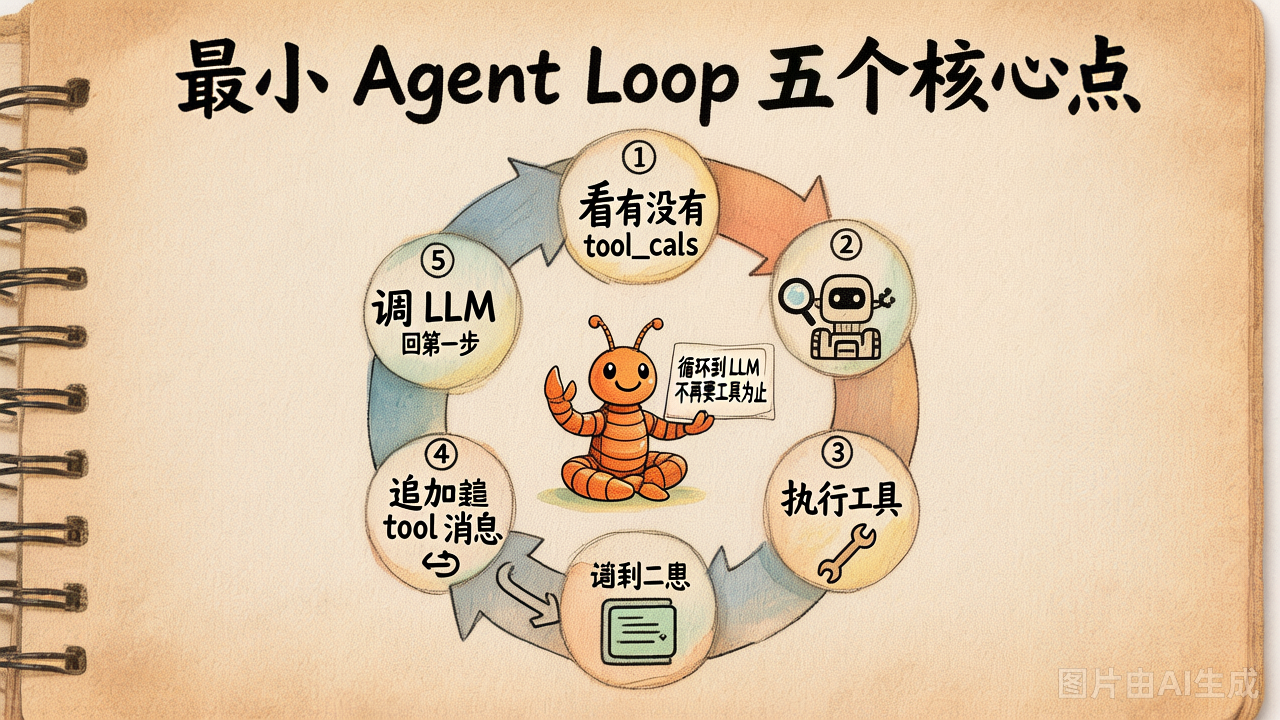
最小 Agent Loop 主体不超过 50 行,5 个步骤反复转:调 LLM → 看 tool_calls → 跑工具 → 拼回 messages → 回到第一步。
今天最后一节,把第 7 / 8 节的零件拼成一个"能干真活"的最小 Agent。
NOTE
到 2026 年,OpenAI Agents SDK、Claude Agent SDK、Claude Code、Codex 等产品都会帮你封装这层循环。但越是使用框架,越要知道底层发生了什么:模型做决策,程序执行工具,消息历史把两者串起来。
核心循环长这样
def run_agent(question: str, max_iters: int = 6) -> str:
    messages = [
        {"role": "system", "content": "你是助手。需要时调用工具。"},
        {"role": "user", "content": question},
    ]

    for turn in range(max_iters):
        # ① 调 LLM
        msg = client.chat.completions.create(
            model=MODEL,
            messages=messages,
            tools=registry.to_schemas(),
            tool_choice="auto",
        ).choices[0].message

        # ② 检查 tool_calls
        if not msg.tool_calls:
            return msg.content                  # ③ 没有 → 结束

        # ④ 执行每个工具,结果以 role=tool 追加
        messages.append(serialize_assistant(msg))
        for tc in msg.tool_calls:
            args = json.loads(tc.function.arguments)
            result = registry.invoke(tc.function.name, args)
            messages.append({
                "role": "tool",
                "tool_call_id": tc.id,
                "content": result,
            })
        # ⑤ 进入下一轮

return "⚠️ 达到最大轮次"就这 30 行。这是大多数工具型 Agent 的最小骨架。真实 Coding Agent 会在外面再包上工具权限、沙箱、上下文压缩、进度 UI、tracing 和评测——复杂的不是循环本身,是循环周围的工程护栏。
5 个核心点逐个拆
核心点 1:每轮都"全量"传 messages
client.chat.completions.create(
    messages=messages,    # ← 注意是完整列表
    ...,
)LLM 是无状态的(Day1 第 2 节讲过)。每一轮你都要把之前所有消息都传回去:
第 1 轮 messages: [system, user]
第 2 轮 messages: [system, user, assistant(tool_calls), tool]
第 3 轮 messages: [system, user, assistant(tool_calls), tool, assistant(tool_calls), tool]
...这就是为什么 Day4 必须做上下文管理——不然 messages 列表会无限膨胀。
核心点 2:用 tool_calls 当循环的"红绿灯"
这是最小循环里最可靠的退出信号:
if not msg.tool_calls:
return msg.content不要看 content 里有没有"完成"两个字,优先看 tool_calls 是不是空。通常模型决定不再调工具时,tool_calls 会是空;生产环境还会叠加最大轮次、超时、预算、人工中止等外部刹车。
核心点 3:assistant 消息必须原样追加
messages.append({
    "role": "assistant",
    "content": msg.content,                # 通常是 None
    "tool_calls": [
        {
            "id": tc.id,
            "type": "function",
            "function": {
                "name": tc.function.name,
                "arguments": tc.function.arguments,
            },
        }
        for tc in msg.tool_calls
    ],
})漏了这条,下一轮模型就看不到自己刚刚"决定调什么"——会原地踏步重新决策。这是新手写 Agent Loop 时最常见的错误之一。
核心点 4:tool 消息必须配 tool_call_id
{"role": "tool", "tool_call_id": tc.id, "content": result}tool_call_id 必须和 assistant.tool_calls[*].id 严格一对一,让模型知道这个结果是哪个调用的。一次有多个工具时尤其关键。
核心点 5:永远要有"刹车"

for turn in range(max_iters):     # ← 上限是必须的
    ...
return "⚠️ 达到最大轮次"为什么?三种典型死循环:
- 模型卡 bug:返回 tool_call → 工具失败 → 模型再调一遍 → 再失败 → ……
- 工具报错没兜底:工具崩了把 exception 抛出来,循环挂了
- 模型反复调 tool:自己也意识不到信息已经够了
几道常见刹车:
| 刹车 | 长什么样 |
|---|---|
| 最大轮次 | for turn in range(max_iters): |
| 超时 | 单次 LLM 调用和工具调用都设置 timeout |
| Token 预算 | 每轮检查累计上下文,必要时压缩或终止 |
| 工具异常兜底 | try/except 把错误转成字符串塞回 messages |
| 同一工具同样参数连续调用 N 次就停 | 进阶:基于历史去重 |
| 人工中止 | 危险动作或长任务允许用户停下 |
今天先实现最大轮次和工具异常兜底;其他刹车会在后续上下文管理、工具集和集成章节里逐步加上。
2026 生产 Agent 的护栏清单
真实生产环境中,护栏远不止"不死循环"。2026 年的最佳实践还包括:
- 工具白名单:只允许调用已注册的工具,拒绝模型"编造"的工具名
- 危险操作确认:写文件、删文件、执行 shell 等行动型工具需要二次确认或 human-in-the-loop
- 输入/输出 guardrails:调用前检查敏感参数,调用后过滤密钥、PII 或过长结果
- 可观测日志:每轮循环记录 tool_calls、参数、结果、耗时,方便排查和审计
- Trajectory evals:不只评最终答案,也评"有没有选对工具、有没有乱重试、有没有越权"
跟 demo_06 的"hand-rolled 版"对比
第 6 节那种"让模型输出 JSON 再 parse"的写法(demo_06 也演示了),跟今天的 tool_calls 写法对比:
| 维度 | hand-rolled JSON | OpenAI tool_calls |
|---|---|---|
| 模型输出格式约定 | 写在 system prompt 里 | 协议保证 |
| 解析失败 | 经常(模型多说一句就崩) | 几乎不会 |
| 多工具并行 | 自己手写解析 | 协议原生支持 |
| 跨厂商迁移 | 每家自己约定 | 概念相同,字段名需要适配 |
但 hand-rolled 那种写法不是没用——Day3 ReAct 范式会用它来解释"思考-行动-观察"的历史写法,也让你看见为什么 Function Calling 会成为拐点。
2026 年的框架把循环藏到哪里了?
如果你用 OpenAI Agents SDK、Claude Agent SDK 或类似框架,经常看不到上面的 for turn in range(max_iters)。框架会帮你做:
| 框架能力 | 底层对应本节哪一步 |
|---|---|
| function tool / hosted MCP tool | registry.to_schemas() |
| built-in agent loop | 调 LLM → 执行工具 → 塞回结果 |
| guardrails / approvals | 工具调用前后的权限与安全检查 |
| tracing | 记录每轮模型调用、工具调用和结果 |
| evals | 评估整条 trajectory,而不只看最后一句话 |
| sessions / memory | 保存或压缩 messages |
所以,框架不是替代 Agent Loop,而是把这个循环包装得更安全、更可观测、更适合生产。
还有什么不在循环里?
今天我们刻意不做的事:
| 不做的事 | 何时做 |
|---|---|
| 上下文压缩(messages 太长怎么办) | Day4 |
| Memory(跨会话持久化) | Day4 |
| 多 Agent 协作 / 思考范式 | Day3 |
| Coding 专用工具集(read/write/edit/grep) | Day5 |
| REPL / 流式输出 / 漂亮的终端 UI | Day6 |
| Skills 系统 | Day7 |
今天只做循环。这是 Agent 的骨架,先有骨架,剩下 6 天再往上长肉。
动手试试
cd labs/02-tools-and-agent-loop
python demo_09_mini_agent.py它会跑 4 个测试任务:
- 现在几点? —— 单工具一轮就完
- 17 × 23 = ? —— 单工具
- 抓 example.com 长度除以 7 —— 串联两个工具,两轮
- 2099 年世界杯冠军是谁? —— 没合适工具,模型应该承认不知道
观察 4 号任务里 Agent 的反应:理想情况是承认不知道;常见错误是"硬调"某个工具。这个失败 case 是今天 Checkpoint 必须交的内容之一。
小结
| 概念 | 一句话理解 |
|---|---|
| Agent Loop 5 步 | 调 LLM → 看 tool_calls → 跑工具 → 拼回 messages → 回到第一步 |
| 退出条件 | 最小判据:tool_calls 为空;生产还要叠加轮次、超时、预算和人工中止 |
| 必须追加的两条 | assistant(含 tool_calls) + tool(配 tool_call_id) |
| 必须的刹车 | 最大轮次 + 工具异常兜底;生产还要权限、日志、评测 |
| 今天不做 | 上下文管理 / 记忆 / 范式 / Coding 工具集 / UI |
理论部分到此结束。下面进 lab:part1 自己实现一个 ToolRegistry,part2 把循环搭起来 + 接 3 个工具。